
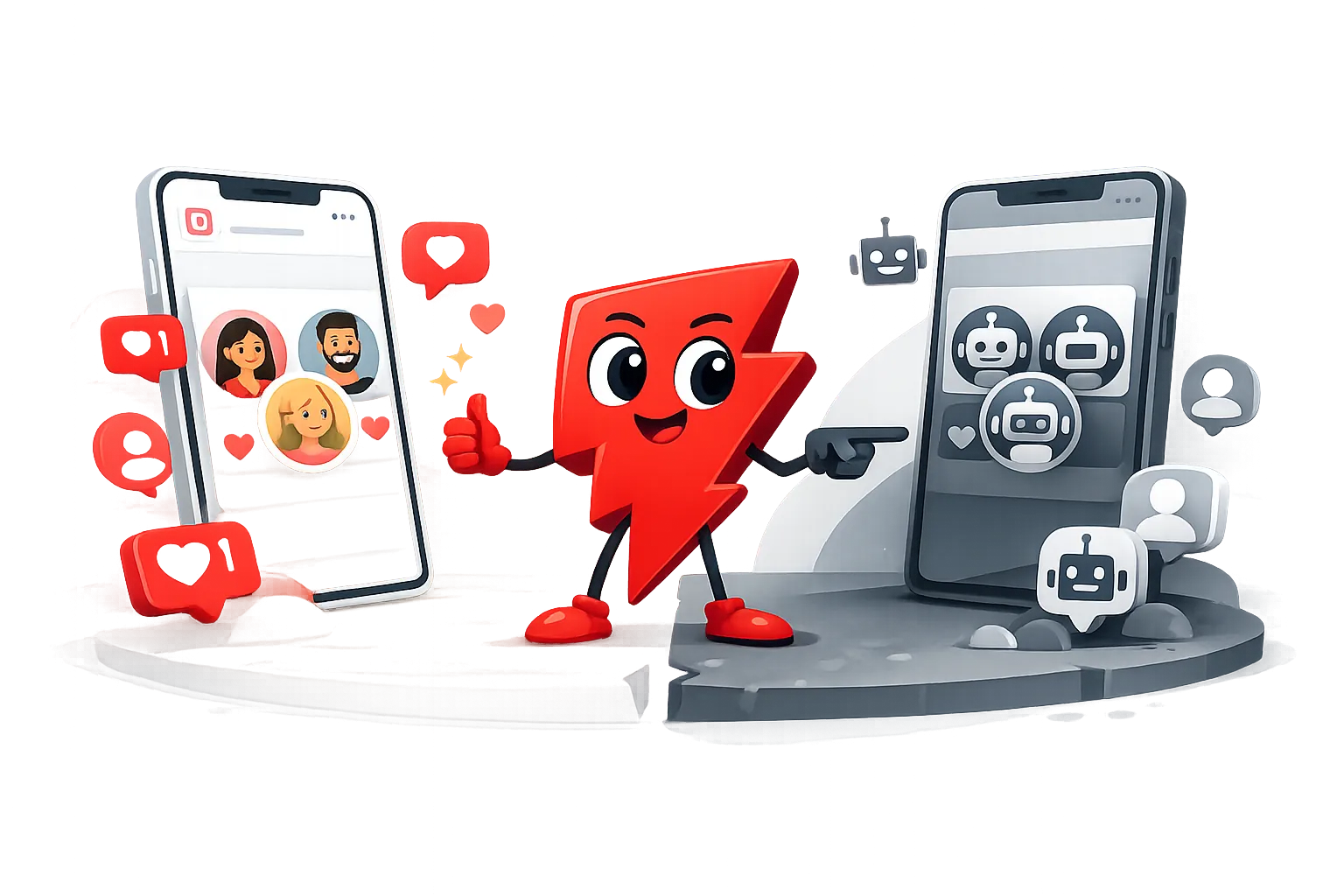

Real vs bot followers: which ones stay
A bot follower is an empty account made by a script. Somebody makes a few thousand of them in a week and sells follows off the pile to whoever is buying. Instagram deletes them in waves, so most are gone within a month.
Every listing says "real". Skip that word and open the accounts you got. A photo, a bio, a few posts, a normal number of people followed: that one will probably still be there next month. No photo, no posts, following 7,000 people, username user84720164: that one will not.
Spotting a bot follower
- Made the same week as thousands of others, often off the same IP ranges or devices.
- No photo, no bio, zero or one post. Username is a word with numbers on the end.
- 800 follows in three hours. Nobody uses the app like that.
- Following 8,000 accounts, 4 following back.
- Never liked a post. Never watched a story.
Instagram sweeps for exactly that. When a sweep hits, the accounts get removed and their follows go with them. Hence the usual complaint about cheap packs: big jump overnight, then a slide two to four weeks later.
What a managed account looks like
Months or years old, with a profile photo, a bio and posts going back a while. It follows a few hundred accounts and has a few hundred followers. It logs in, likes and follows at about the pace a person would, so one follow from it looks like nothing.
That is why it gets past the sweeps. It is still an account run for social proof and it did not choose you. Sellers who promise "100% real active fans" are describing something they do not have. What you can actually pay for is the follower staying on your count.
Managed vs bot, side by side
| What you look at | Managed account | Bot account |
|---|---|---|
| Profile photo and bio | Filled in | Missing or default |
| Account age | Months to years | Days to weeks |
| Posts | Some, spread over time | 0 to 2 |
| Followers / following | Plausible, like 200 / 400 | Extreme, like 2 / 8,000 |
| Gets through sweeps | Usually | No, it's what the sweep is looking for |
| Cares about your posts | No | No |
Last row: same answer for both. The rows above it decide who is still on your count after a sweep.
How Instagram finds bots
Three places it looks:
- The account. Age, posts, logins, devices, what it engages with. A two-week-old account that only ever follows people is first in line.
- The crowd around it. 5,000 accounts following the same targets inside 48 hours is visible from Instagram's side even when each account on its own looks borderline fine.
- Your profile. You normally get 5 to 10 followers a day, then 1,000 land in six hours. That spike gets looked at, and so do the accounts behind it.
A bot fails all three. An older managed account, delivered over hours or days instead of in one go, usually passes.
What bots do to your engagement rate
Bots add to the follower count and nothing else. No likes, no story views, no profile visits. Instagram uses engagement rate, the share of your followers who interact with a post, to decide how many people to show it to.
- Before: 800 followers, 40 likes a post. That is 5%.
- You buy 1,000 bot followers.
- After: 1,800 followers, still 40 likes. That is 2.2%.
Same posts, same likes, and the account now looks less than half as interesting to Instagram. Nobody notices this at first because no number went down.
Managed accounts like the odd post, which helps a little. If the ratio matters to you, add likes on purpose. Our monthly follower plans come with free likes for this. One-time follower packs do not, so pair a pack with a likes pack on the posts you care about.
Price per follower that's still there
Price per 1,000 is the wrong thing to shop on. What matters is what you paid per follower that's still on your account in 90 days. A bot pack for a dollar or two can easily cost more per surviving follower than a managed pack that cost several times as much on day one, and it hurts your engagement rate on the way.
Then there's the top-up treadmill. If most of a batch disappears within three months, you keep reordering just to hold the same number, and your count goes up and down instead of growing. We don't publish a retention percentage for our own packs, because we can't measure it properly yet, and you should be suspicious of anyone who quotes you a neat one. Run the check below and see for yourself.
Checking what you got
Don't take any seller's word for quality, ours included. Checking takes five minutes.
- Open your followers list and look at the newest ones, the accounts that just got delivered.
- Tap into 20 of them at random. Don't just pick the ones that look good.
- On each one, look for: a photo, a bio, any posts, roughly how old the account is (from the post dates), and how many it follows compared to how many follow it.
- If more than about a third have no photo, no posts, or follow thousands with almost nobody back, you got a bot-heavy batch, whatever the listing said.
Then check again in 90 days. Screenshot your count on delivery day and again three months later, take off the followers you gained on your own (Instagram Insights shows this under Total followers), and see how much of the order is left. If a lot is missing, the accounts were low quality, and if the seller offered a refill, that's when you use it.
Checking someone else's account
The same check works on accounts that aren't yours. That's handy if you're about to pay an influencer, or a competitor suddenly doubled overnight. Two quick tells: a follower graph that's flat, then jumps straight up overnight, then goes flat again, and a followers list full of the empty profiles above. Fake-follower audit tools are a fine first look, but they work from a sample and managed accounts can fool them, so use the score as a reason to check by hand. For a creator deal, an account on a 0.5% engagement rate when accounts that size usually get 2 to 3% is the number to bring up before you pay.
What we sell
We sell managed accounts, not bots, and we don't call them real people. Each one has a profile picture, a bio and posts. Orders go to a public username, and we never ask for your password. If a seller asks for your login, don't use them.
Small packs usually finish within hours. Bigger ones are spread out over hours or days so your follower count doesn't jump all at once. Some followers drop off over time with every provider, ours included. Refills depend on the pack you pick: where the pack has a refill window, we top the count back up if it drops inside that window. Packs start at $3 for 100 followers, and 1,000 is $12. You can see all the sizes on the Instagram followers page.
Common questions
Can I spot a bot seller before I pay?
Mostly, yes. Followers at a dollar or two per 1,000 are bots. Otherwise look for a refill window with a number of days on it and an email address that gets answered, then buy their smallest pack and open 20 of the profiles.
What do "active real followers" and "High Quality" mean?
Whatever the seller wants. Two tiers with different names are often the same accounts at two prices.
Is it legal to buy Instagram followers?
We don't know of a law against it in general, but Instagram's rules say no, and swept followers are what usually happens. If you're going to show the numbers to brands to get paid deals, read the FTC's guidance on fake social media indicators first. Don't ever give a seller your password.
Sources: Instagram Community Guidelines and Meta's inauthentic behavior standards.